Who are Arsenal: An Interrogation of Identity
Since the beginning of Mikel Arteta’s tenure at Arsenal in 2019, the club have not simply improved; rather, they have shifted.
Not gradually. Not subtly. But instead in what seem to be phases.
Phase One (2019–2021): Survival
Phase Two (2022–2024): Declaration
Phase Three (2025–2026): Calculation
Therefore, the question is not whether Arsenal are “better” but rather who they have become in their quest for legacy.
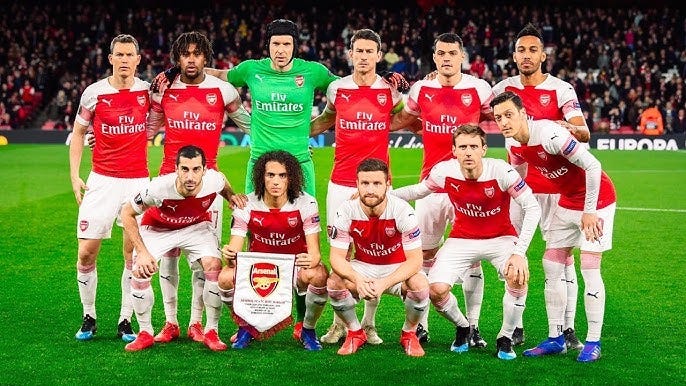
2019 Arsenal (yikes)
PHASE ONE: Survive.
Despite resulting in the only true major silverware of Mikel’s appointment, (so far), early Arteta football was a far cry from the stability and control held central to Arsenal’s on-field philosophy.
It was safe and pragmatic, looking to compensate for a lack of quality for resolute compactness. Although Mikel would eventually opt for a 4–2–3–1, a less than glamorous 3–4–3 became the primary blueprint moving forwards. This consisted of deep block defending, compressing space between the lines and a true weaponisation of transition. Ultimately, defensive resilience sat in the place where aesthetic flair once reigned.
Forwards such as Alexandre Lacazette and, most notably, Pierre-Emerick Aubameyang served primarily as outlets. Here, transition became opportunity, and the control we see favoured today was rendered secondary.
Bearing the scars of the past, this Arsenal was fractured both on and off the pitch. Traumatised by the latter Wenger, Ljungberg and Emery years, there was a complete disconnect between the club and its fanbase. Moreover, players with bloated wages and egos alike.
Instability without identity.
It was clear that before Arsenal could impose themselves, the ship had to be steadied….
And Mikel did just that.
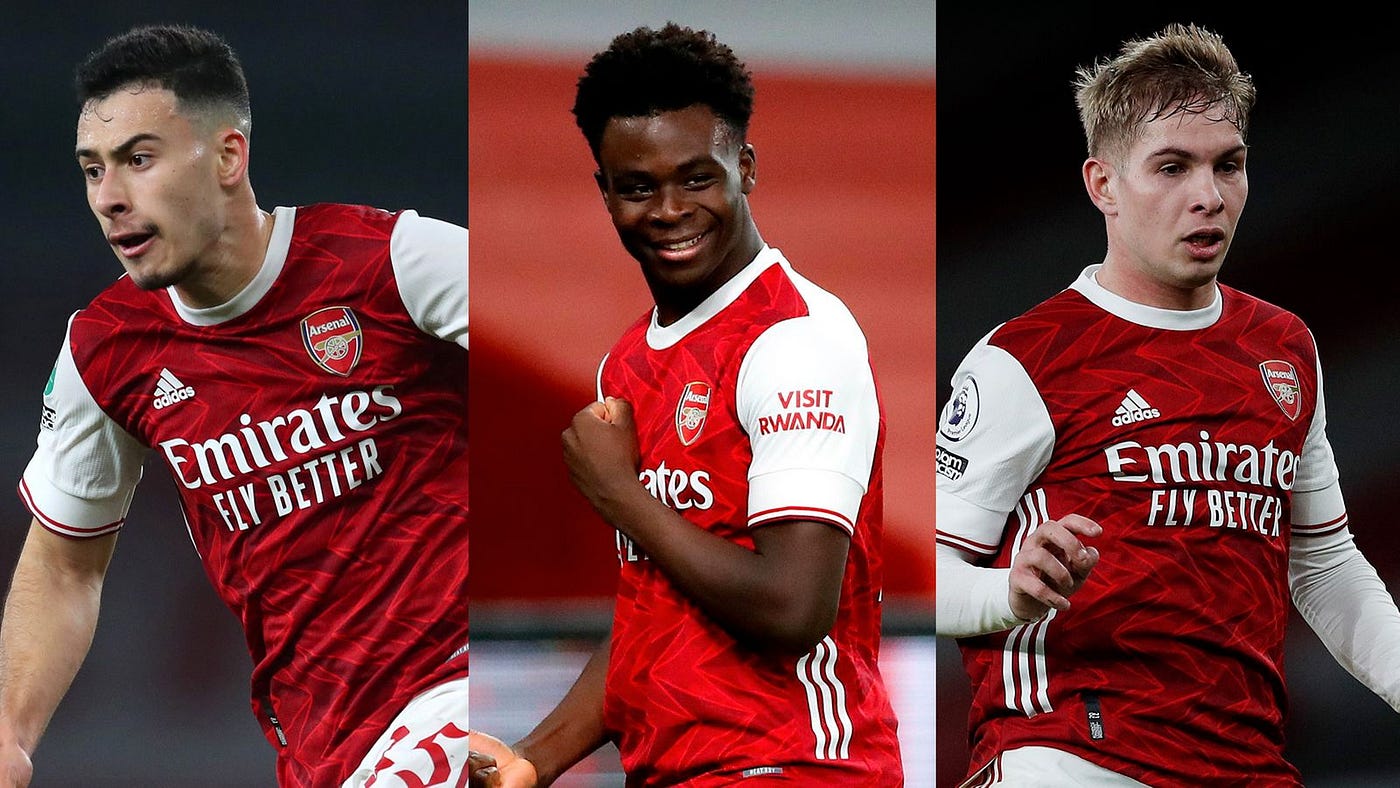
PHASE TWO: The Arrogance of Youth
An FA Cup later, Arsenal witnessed the emergence of Bukayo Saka, Emile Smith Rowe and Gabriel Martinelli, all of whom contributed to a growing sense of resurgence.
Belief began to sprout, and this became visible.
The once pragmatic 3–4–3 gave way to a brave 4–3–3 built on territorial dominance. Full-backs now consistently inverted into midfield during build-up, forming a 2–3–5 to allow sustained progression. This pushed the defensive line higher, urging belief. Suddenly they pressed harder. More aggressive. True coordinated, heavy-metal pressing that turned Arsenal into a side to be reckoned with.
Where Phase One relied on outlets, Phase Two introduced structural superiority. An idea perhaps lost to Unai Emery’s ‘controlled chaos’ ethos. To reinforce this control, the club invested €35 million into labelled ‘failed wonderkid’ Martin Ødegaard after an initial loan move. While this move initially met fan resistance, he soon became a fan favourite and club captain, serving as a much-needed creative spark.
Most notably, Hale End graduate Bukayo Saka became a prolific weapon in isolation on the right flank, feeding the feeling of inevitability that surrounded the club.
Opponents would be penned into their own half, torn apart pass after pass with surgical precision. Counter-pressing became aggressive. Suffocating even. Risk was embraced high up the pitch.
2022/23 particularly felt like the arrogance of youth — raw, brave, fearless… but ultimately flawed. This Arsenal side seemed to press with a hint of late teen naivety, perhaps revelling in the belief that their momentum would carry them through. Comeback wins such as Liverpool, 3–2, West Ham, 3–1, and, unforgettably, Reiss Nelson’s last-minute 25th Bournemouth winner showed that at times it did.
However, other times it didn’t.
The 4–1 defeat to Manchester City at the Etihad serves as a key example of this. While on paper it spells a collapse, ultimately it reveals a greater confrontation. The heavy-metal, man-to-man pressing style that suffocated other sides into submission seemed futile against Guardiola’s men.
Pep opted for patience, baiting the press, bypassing the first wave and platforming Kevin De Bruyne and Erling Haaland in an attempt to expose the acres of space left behind.
Whether this is naivety on Mikel’s part or a commitment to ‘die by the sword’ is ultimately a subjective matter.
Ultimately, what remains clear is that 2023/24 and 2024/25 brought a clear revision of this teenage boldness.
Signings:
- Declan Rice (€116.60 Million)
- Kai Havertz (€75 Million)
- David Raya (Initial €3 Million Loan + €35 million transfer fee)
- Jurrien Timber (€40 Million)
- Mikel Merino (€32 Million)
- Riccardo Calafiori (€45 Million)
Academy graduates Ethan Nwaneri and Myles Lewis Skelly notably brought a newfound sense of controlled aggression. This stage did not resemble a complete shift in tactical dynamics but instead a refining of its downfalls. Therefore, the press was sharper. The spacing is cleaner.
It felt like early adulthood — a sense of individual discovery where confidence rose and flaws were smoothed at the edges by the sandpaper of time.
The squad remained eluded by silverware. However, their identity was clear.
They had imposed themselves on the league and were here to stay.
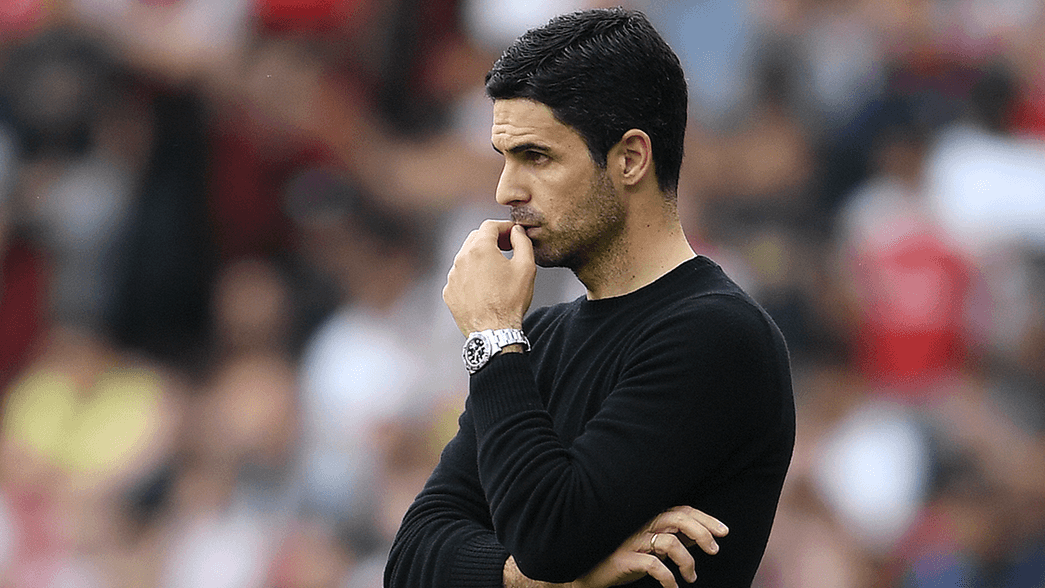
PHASE THREE: Mid-Twenties Uncertainty?
Then something shifted.
Where Phase Two felt like a dictatorial imposition, Phase Three feels calculated, data-driven and, most notably, modular.
Arsenal are now arguably the most tactically adaptable side in the English Premier League, able to:
- Adjust build-up routes in real time based on opposition press
- Shift Midfield rotations depending on emerging threats
- Modulate pressing intensity
to name a few.
On paper, this details evolution. However, in reality this feels like self-awareness.
The once suffocating pressure has now fallen back into managed control. Their tempo now seems deliberate, and possession is probed, at times resorting to horseshoe football as a means of safe distribution. Territory is still gained — but at the sacrifice of Arsenal’s trademark fluidity.
When against the Real Madrid’s and Manchester City’s of the world, despite relatively positive records against both clubs sepcfically, Arsenal no longer look to overwhelm but instead to safely neutralise. In turn, resulting in what can be a frustrating, ‘handbrake-raised’ watch.
It certainly is intelligent. It certainly is mature… but it is REACTIVE. Rather than Phase Two’s confident “How do you stop us?” Phase Three subtly plots “How do we stop you?”
In other words, if 22/23 was the exuberant youth and 23/24 was grounded early adulthood, 24/25 and 25/26 feel like the onset of mid-twenties uncertainty — talented, certainly capable but all of a sudden hesitant. This begs the question…
Is it fatigue? Games are coming thicker and faster than ever before, after all. Champions League expansion, international breaks, domestic cups. The physical toll is REAL.
Is it strategic? It stands to reason that modern football may no longer favour individual flair but rather game management and risk management. A game of percentages rather than rainbow flicks.
Perhaps it’s psychological. It is clear to the world that this squad bears the scars of failure after failure after failure. Years of pushing Manchester City to the wire—only to stumble over percentages—are likely to have recalibrated the risk threshold. In turn, reducing the value of relentless bravery.
It truly begs the question, have these experiences produced refinement or restraint? I suppose it’s a matter of subjectivity.
With Arsenal’s variety of attacking profiles, limitation feels increasingly unlikely to be a quality issue and more towards instruction, which makes the uncomfortable question unavoidable:
Who are Arsenal now?
Are these changes a result of maturity or simply the result of managerial caution?
Well….
Ultimately, the answer will be engraved in silver elation.
If Arsenal lift the title, I see them as the ‘chameleons’ of the Premier League. Adaptability will become their identity, serving as the final arc of a story for the ages and likely the start of a dynasty. (fingers crossed) However, if they fall short for the fourth time running, restraint will look less like growth and more like fearful hesitation.
Titles sanctify caution, but failure exposes it.
Therefore, to me at least, Arsenal’s true identity remains enigmatic at the least — balanced somewhere between the need to be “…the kings of everything” and calculated control.