"If I have to make a tackle, I have made a mistake".
A famous quote by Paolo Maldini, one of the best defenders of all time. Although sometimes misinterpreted (Maldini himself has also called tackling an art), it does reveal a massive flaw in evaluating defenders with data. The defenders who make the most tackles, blocks, or interceptions are not by definition the best defenders.
This can easily be explained by looking at a goalkeeper's saves. The more shots you face, the more chances for saves you have. Additionally, the quality of a save is dependent on the quality of the shot. Therefore, save volume and percentages have been replaced by comparing goals conceded with post-shot expected goals (xG) against. For defenders, the more active your direct opponent is, the more chances you have to make defensive actions.
One solution that has emerged in the football analysis scene is adjusting for possession (Padj). The idea is that by normalising defensive actions to a base level of 50% possession, we get a fair evaluation of which defenders are most valuable (there are more sophisticated methods; Wyscout adjust to 30 minutes of possession, for example). With this methodology, Barcelona's Eric Garcia ranks as the 6th "best" centre back in Europe's Top 5 leagues according to Scout Lab's Padj Defensive Ground Duels won per 90 minutes, with 2.74. We will refer back to Eric Garcia later in this article.
A second step in improving defensive action evaluation is the introduction of Valuing Actions by Estimating Probabilities (VAEP) models. It assigns a value to each on-the-ball action in event data based on its impact on the game outcome while accounting for the context in which the action happened (KU Leuven, 2019). Scout Lab's version of this model for defensive actions leads to the following top 20:
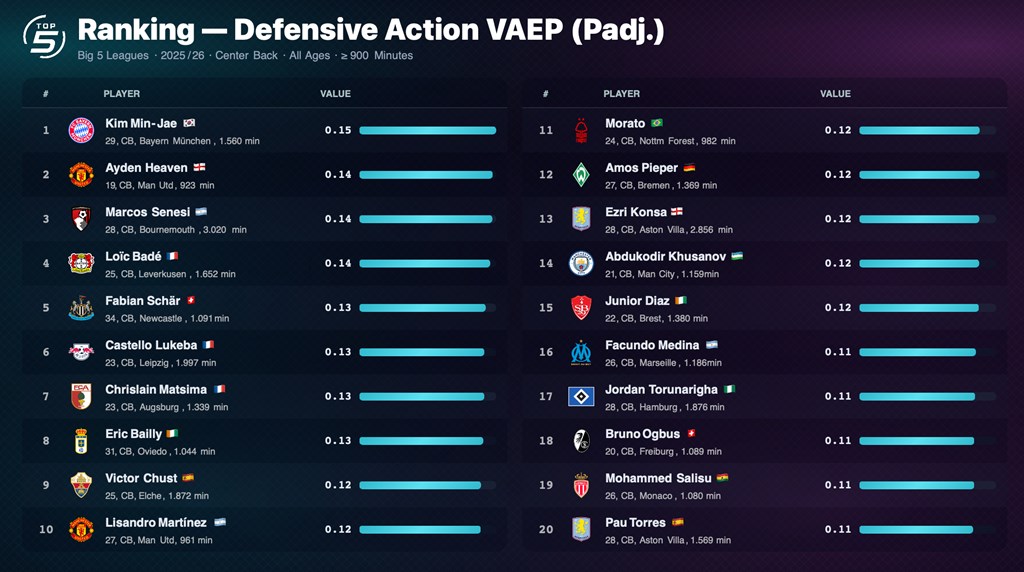
However, this still leaves us with the Maldini-problem. The now 32 years old Eric Bailly ranks 8th across the big 5 leagues, playing for Oviedo. With the 8th best centre back in Europe, you would expect them to perform well defensively. Contrarily, they currently rank 20th in La Liga, having conceded the 18th most goals and 17th most xG. Among full backs, Fulham's Timothy Castagne ranks 1st in this metric; another name to remember.
Two weeks ago, I developed a methodology to solve the Maldini-problem. The best defences and individual defenders in the world are characterised by preventing threat before they have to intervene. Arsenal's Saliba and Gabriel are often praised for making their direct opponent "invisible". This leads to impressive defensive performances where they don't make many defensive actions that appear in event data. These actions are also not included in VAEP models. To measure a defender's overall impact, I used Understat's data to track open play xG and assists (xA) from direct opponents.
The initial calculation of threat by direct opponents of centre backs led to the plot below.
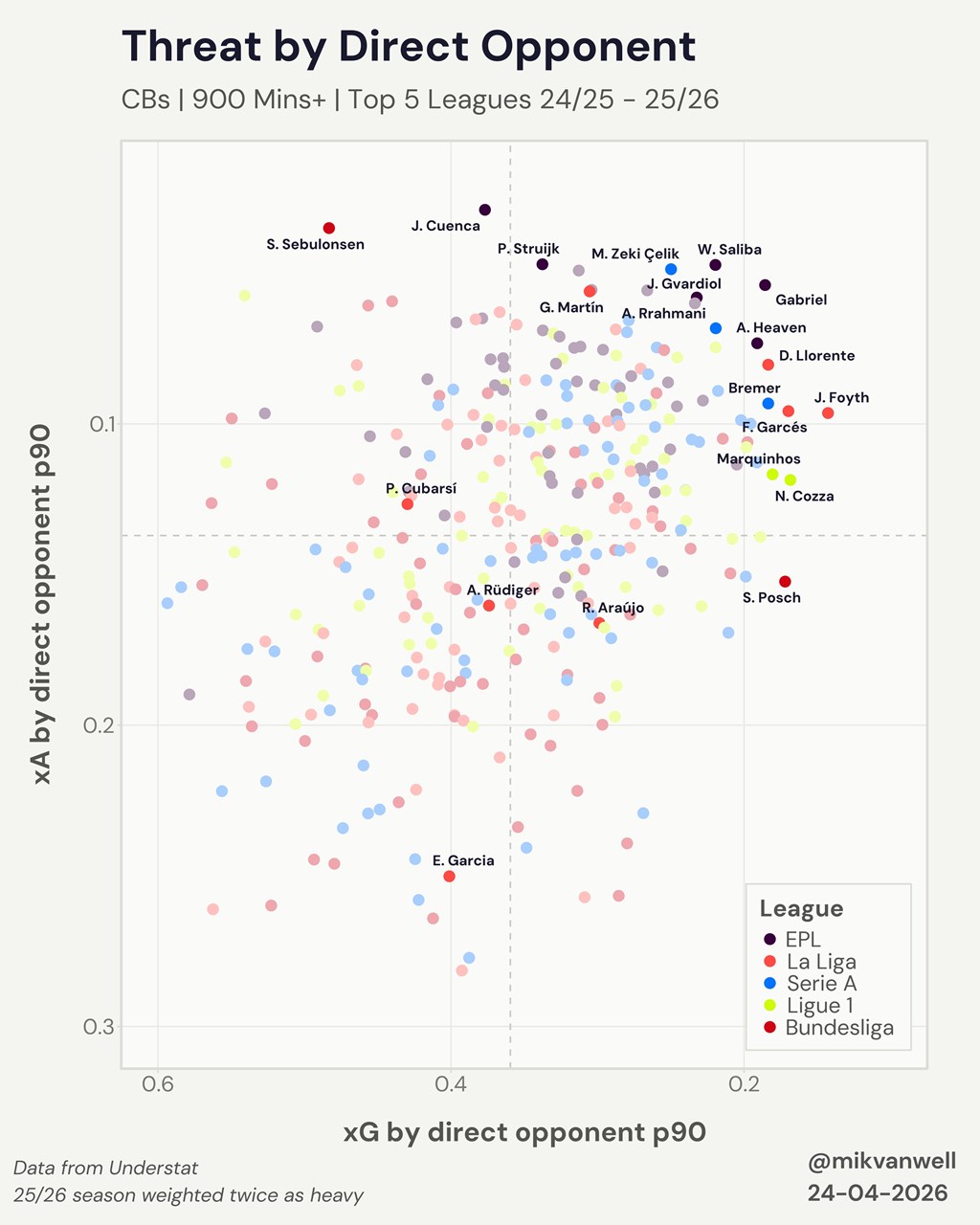
The main takeaways? Unsurprisingly, Arsenal CBs dominate. However, both axes are highly sensitive to team level and tactics. They should mostly be used to compare players within teams or compare team-wide strengths and weaknesses. For example, opposing strikers generally thrive against Barcelona, with many of their centre backs ranking far below most other players at elite clubs. Eric Garcia especially struggles in defending his direct opponent(s). His high ranking in defensive ground duels has not led to actual threat prevention. Surprisingly, left back Gerard Martin ranks much higher than his Barça teammates, when playing as a centre back!
Villarreal's Juan Foyth conceded the least xG and combined expected goal involvements, far less than his teammates.
To improve the interpretability of individual defensive value, we can expand this method to include team-wide xG conceded. The plot below is covering the same dataset as earlier, but showing relative threat by direct opponents.
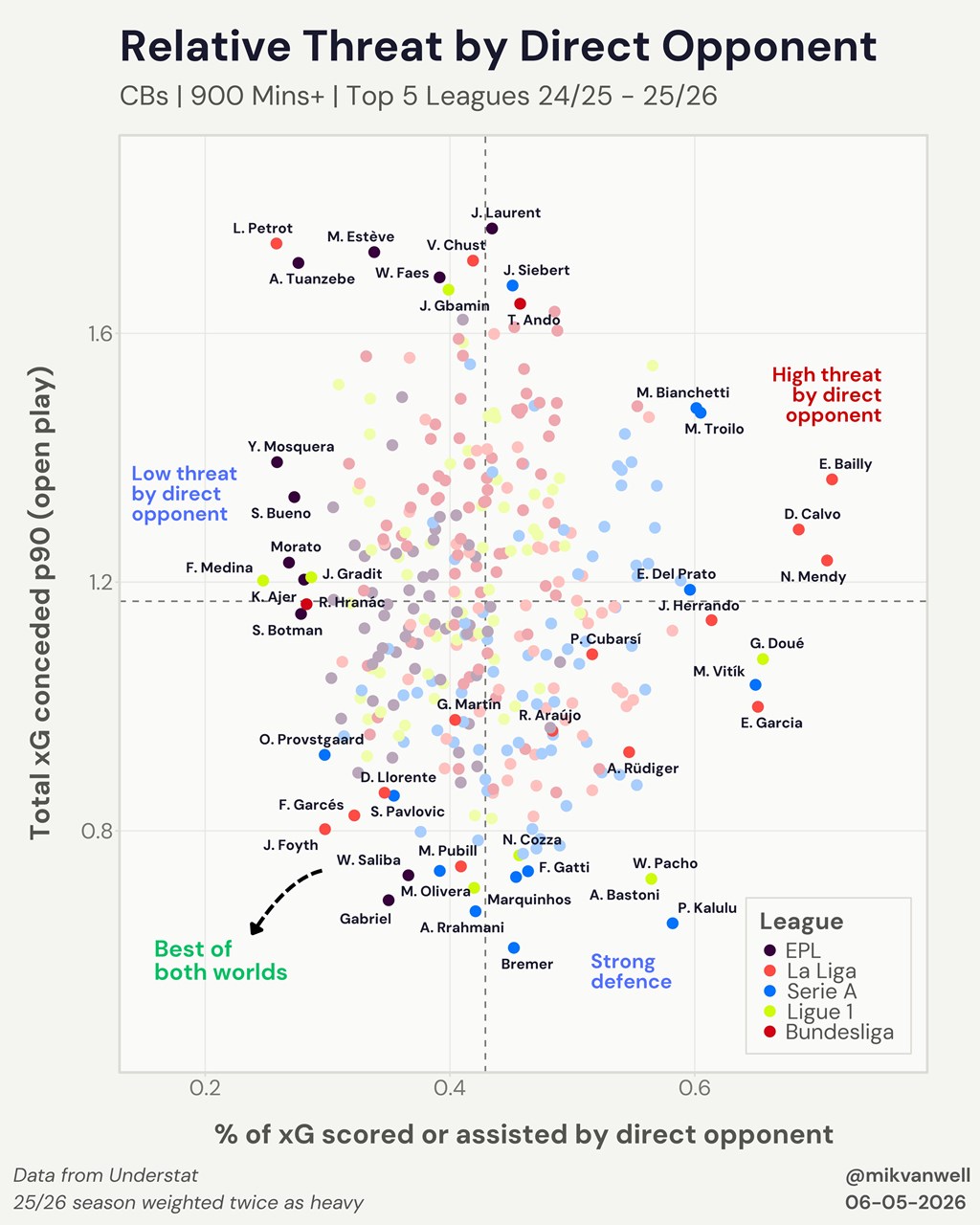
When players on the bottom of the plot are on the pitch, their teams conceded low total open play xG. Players towards the left excel in preventing their direct opponent from scoring or assisting goals.
A visible pattern is that Serie A players appear more often towards the bottom right. Their teams concede a low total volume of xG, but a higher percentage of threat is created by strikers, due to the popularity of formations with two strikers and the lack of depth in terms of dangerous wingers. Contrarily, Bundesliga players mostly rank in the top half of the chart, showing higher open play xG per match. Premier League players tend to show up on the left side of the plot, indicating low expected goal involvement by strikers. Moving from a high-scoring league to the toughest league for strikers might explain the many failed transfers from Bundesliga centre forwards to the Premier League.
Individually, Arsenal's centre backs are shining again, improving their team's overall defence and conceding relatively low threat by their direct opponent. Juan Foyth ranks close to them, as did Alaves' Facundo Garcés, Betis' Diego Llorente, Milan's Strahinja Pavlovic, and Lazio's Oliver Provstgaard.
In terms of players that stand out negatively, we see some familiar names. Eric Garcia ranks very high in terms of threat by his direct opponent, although his team's overall defence doesn't decrease when he is playing. And the other Eric, who ranked as the eighth-best defender while playing for Oviedo? He is the worst defender in the entire dataset based on relative threat by direct opponent. It's up to you to determine which model more accurately reflects Bailly's actual level.
I have also applied this model to full backs:
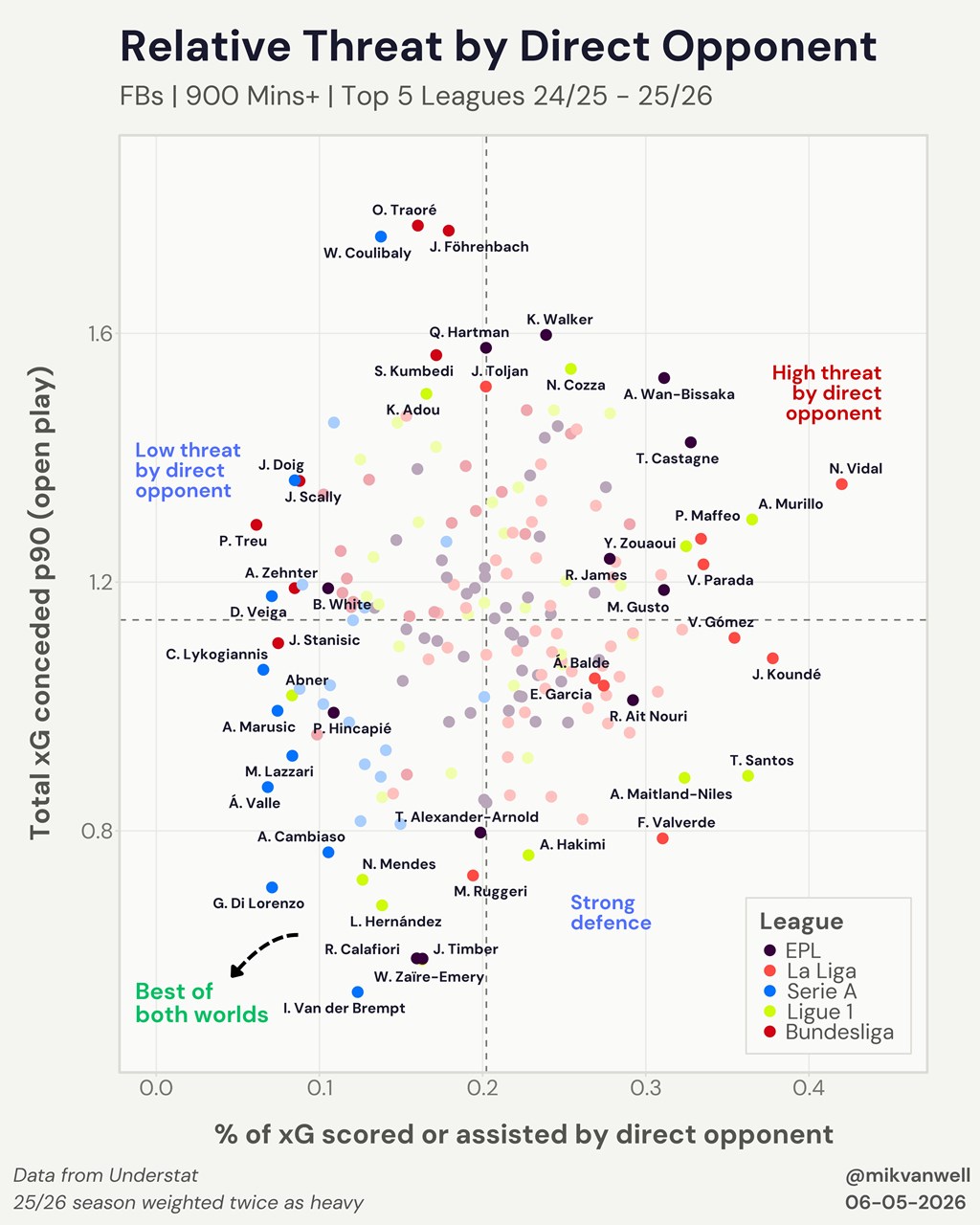
Considering the patterns among centre backs, it's logical that we see the opposite Serie A effect here: lower relative threat by wingers. La Liga's full backs generally struggle with defending their direct opponents however. Oviedo's Nacho Vidal ranks last in relative threat, whilst Jules Koundé and Federico Valverde also show up on the wrong side of the graph. And poor Eric Garcia can't catch a break...
He has also played enough minutes as a full back to qualify and again ranks below average in defending his opponent, although not as bad compared to his teammates as at centre back.
If we consider team-wide impact, Chelsea's right backs stand out negatively. Both Malo Gusto and Reece James are in the worst quadrant of the graph. One of the players that has performed even worse than them is Timothy Castagne. The Belgian right back is not as defensively sound as his VAEP suggests.
In terms of positive outliers, Bayern's Josip Stanisic is one of the few Bundesliga full backs in the bottom left quadrant, allowing very low threat by his direct opponent. His 1v1 defending might deserve some justice after the slander he received based on his performance against Kvaratskhelia. Who wouldn't struggle against the Georgian winger? Arsenal fans will certainly hope for Jurriën Timber to return ahead of a possible Champions League final against either Luis Díaz or "Kvaradonna". Although he and Ricardo Calafiori rank lower than Ben White and Piero Hincapié in terms of relative threat by opponent, Arsenal defend much better as a team with their first choice full backs on the pitch.
Talking about PSG; three of their full backs rank within the "elite" section of the graph. Only Achraf Hakimi allows above average relative threat, although he makes up for that with his offensive contribution (in my opinion).
Among the many Serie A full backs who perform well in this metric, Giovanni di Lorenzo and Andrea Cambiaso ranked especially high. The standout full back in Italy, however, was Ignace van der Brempt. He ranks within the 85th percentile in relative threat by direct opponent and when he is on the pitch, Como concede the lowest open play xG of any team in Europe.
To make the model even more sophisticated, we could remove the xG value of shots that were blocked by the defender in question from his direct opponent's xG tally. I wrote about this metric in a different article. However, I would need a different data source, as Understat doesn't track who blocked a shot.