Arsenal’s 2025/26 Premier League triumph will be remembered for years to come — most notably for their defensive dominance, but also their territorial control with and without the ball.
But perhaps no decision decided Arsenal’s fate more than David Raya’s introduction over fan favourite, Aaron Ramsdale.
Here, what initially appeared to be ruthless selection revealed itself as transformational. Raya did not simply improve Arsenal’s game, he fundamentally transformed the club’s ability to control matches — through possession, territorial control and a formidable defensive stability that often snuffed out danger before it had the chance to spark.
Redefining Control
Despite initial assumptions, Aaron Ramsdale’s replacement was not a simple personnel change.
Following respected shot-stopper Bernd Leno, Aaron Ramsdale resembled a goalkeeper capable of performing at the highest level. Looking back, he represented much of Arsenal’s early identity under Arteta — emotional, energetic and driven by passion rather than structure.
Perhaps this is why the decision felt so extreme.
Naturally, many felt that Raya’s arrival was unnecessary, some labelling him as the result of Arteta “trying to fix something that was not broken”.
Never one to pay attention to media criticism, it was at this point that his thinking seemed to extend beyond traditional shot-stoppers. Rather, envisioning his goalkeeper as a ‘quarterback’ of sorts, capable of influencing possession and territorial domination consistently.
Not afraid of replacing fan favourites for the sake of the club, Arteta backed his vision away from emotional momentum and toward systemic control — a team increasingly built around risk management, mitigating instability before it had the opportunity to rise.
Under Pressure
What truly separated Raya from Ramsdale was never shot-stopping ability alone. Rather, it was his function in Arsenal’s ever-evolving system.
Arteta did not just want a goalkeeper capable of effective distribution; he wanted one fully integrated into Arsenal’s structure. In this context, Raya became a key component of Arsenal’s buildup, constantly serving as the initial outlet during the first phase of possession.
Data analysis clearly reinforces this. This Premier League season alone, Raya recorded 1,429 touches, an exceptional figure for a goalkeeper and one that underlines just how integral he became during buildup. Put simply, Arsenal no longer build from their goalkeeper — rather, they build through him.
This shift is especially visible in Raya’s distribution. Between the 2024/25 and 2025/26 campaigns, his long passing profile rose dramatically from the 27.5th percentile to the 83rd percentile, most clearly reflecting a growing willingness and therefore trust in him as a consistent avenue of ball progression.
Moreover, rather than safe horseshoe recycling, Raya’s elite distribution allowed for a variety of differing ways to manipulate opposition pressure. Whether playing disguised reverse passes to wrong-foot a pressing striker or pinpoint deliveries into wide channels, his vision, composure under pressure and distribution repeatedly allowed Arsenal to entirely bypass the opposition press.
In turn, Arsenal became adaptable, less predictable and therefore far harder to disrupt.
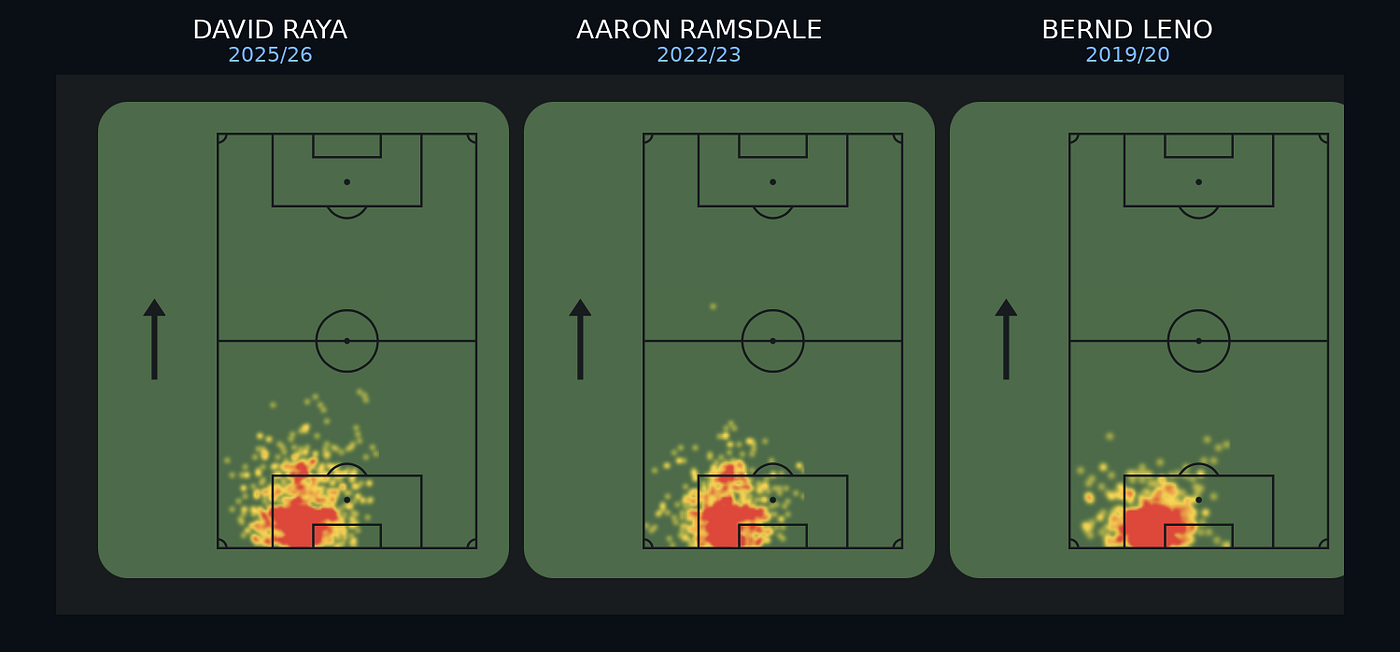
Heat Map comparison (SofaScore)
Space Invaders
If Raya’s distribution transformed Arsenal’s ability to deal with pressure, his positioning enabled the side to exploit the space behind it.
Compared to predecessors such as Ramsdale and Leno, Raya operated noticeably higher and more aggressively both inside and outside possession. Moreover, his heat maps consistently placed him further outside his penalty area and centrally involved during buildup, reflecting a growing trust in Raya’s ability to sweep and therefore sustain pressure higher up the pitch.
Courtesy of Sofascore, this trust was reflected numerically too. Raya completed 707 accurate passes during Arsenal’s title-winning campaign, comfortably exceeding Ramsdale’s 591 during 2022/23 and Leno’s 578 in 2019/20. His distribution also became increasingly expansive. Raya averaged 5.3 long balls per game compared to Ramsdale’s 3.6 and Leno’s 2.5, underlining a growing ability to retain possession and manipulate presses.
With Raya sweeping behind Arsenal’s defensive line, Arteta’s side became able to sustain territorial pressure without exposing the space in behind. On average, Arsenal’s back line remained compact around the halfway line, with its midfield shape maintained during prolonged periods of possession and defensive transitions becoming easier to contain.
Here, Raya’s influence became less visible, but no less significant. This season alone, Raya recorded 304 recoveries alongside 19 clean sheets, resulting in just 26 league goals — the best defensive record in the league. For comparison, while generally considered the better traditional shot-stoppers, Ramsdale conceded 43 goals during the 2022/23 season while Leno conceded 39.
Ultimately, while Raya is considered further away from the stereotypical shot-stopping archetype, his performances increasingly validated Arteta’s decision. Securing his third consecutive Premier League Golden Glove, Raya became symbolic of a different kind of keeper — one rooted not solely in spectacle (although certainly capable of it), but in control and prevention.
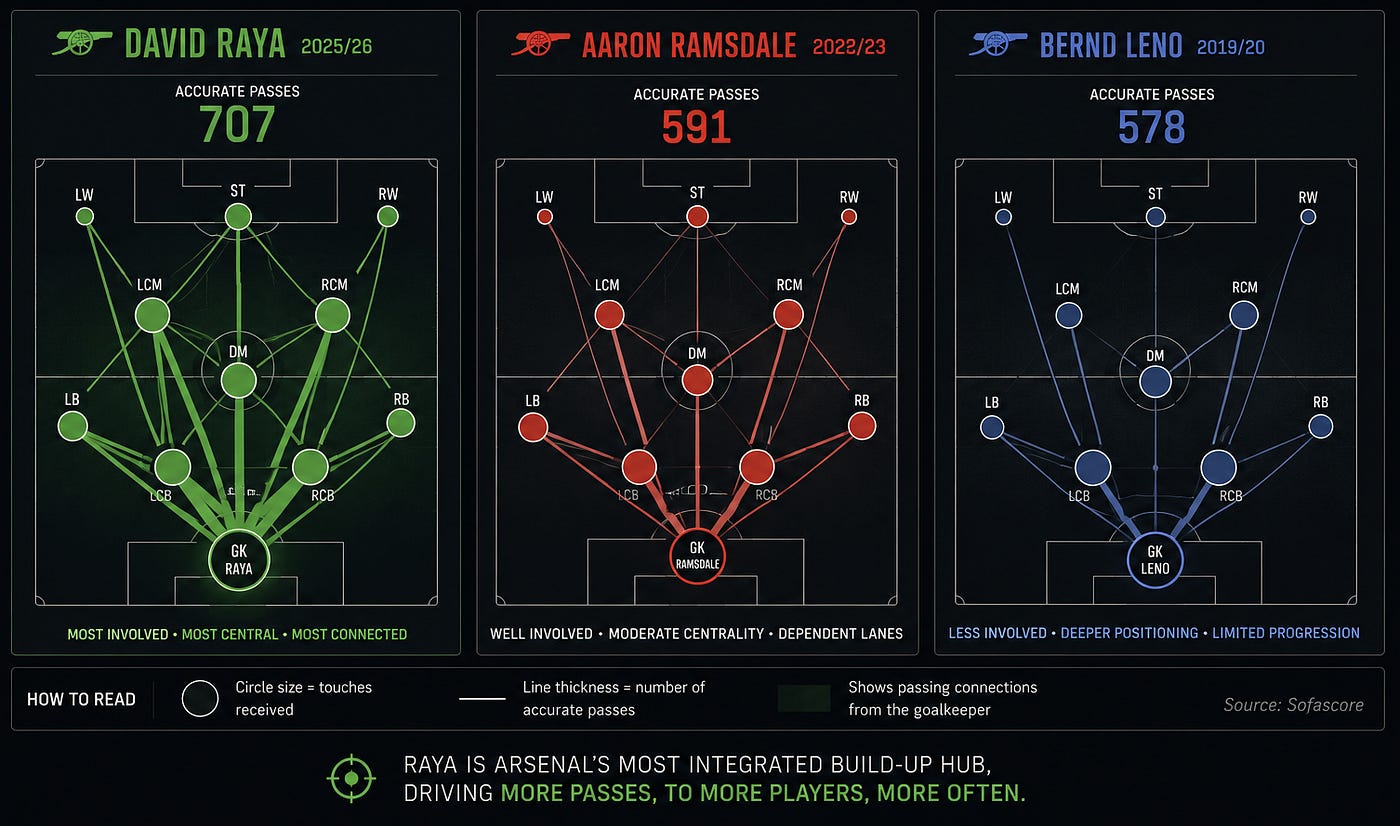
3 Way Pass Comparison
Ice in the Veins
Perhaps the clearest indication of Raya’s importance lies in his composure, rarely overwhelmed and seemingly a step ahead at all times.
In a sport traditionally judged through spectacle — reflex saves, goal-line clearances and flying fingertip stops, Raya goes somewhat under the radar. Yet Arsenal’s title-winning campaign revealed an increasingly common kind of goalkeeping influence: one built less on reaction and more on prevention, emphasising sweeping, positioning and distribution as key attributes to prevent attacks from fully developing.
In other words, the better Arsenal functioned, the less visible Raya became.
His 19 clean sheets and 26 league goals conceded reflect far more than isolated shot-stopping quality. While his one-on-one ability and elite shot-stopping were certainly key to Arsenal’s campaign, his influence mostly arrived before the shot itself — sweeping his area to close down balls over the top, recycling possession under pressure or allowing Arsenal to immediately regain control after transitions.
This continued across the Champions League too, recording 9 clean sheets, 102 recoveries and just 4 goals conceded in 13 appearances. In turn, showing the trust in him from his teammates, where his anticipation and composure were constantly relied upon as much as his shot-stopping ability.
That is what separates Raya from Ramsdale, and more so from Arsenal’s legacy goalkeepers. Not his ability to rescue games alone, but a sense of inevitability in snuffing out any danger before any incentive to rise.
Etched into History
Arsenal’s 2025/26 title-winning side — perhaps soon to be dubbed, in Thierry Henry’s words, “The Unforgettables” should they complete a historic European double — will deservedly be defined by its defensive grit and resilience in the face of adversity.
However, beneath it all sat one defining constant.
Control.
And ultimately, no player represented this more than Arsenal’s pillar of stability:
David Raya.